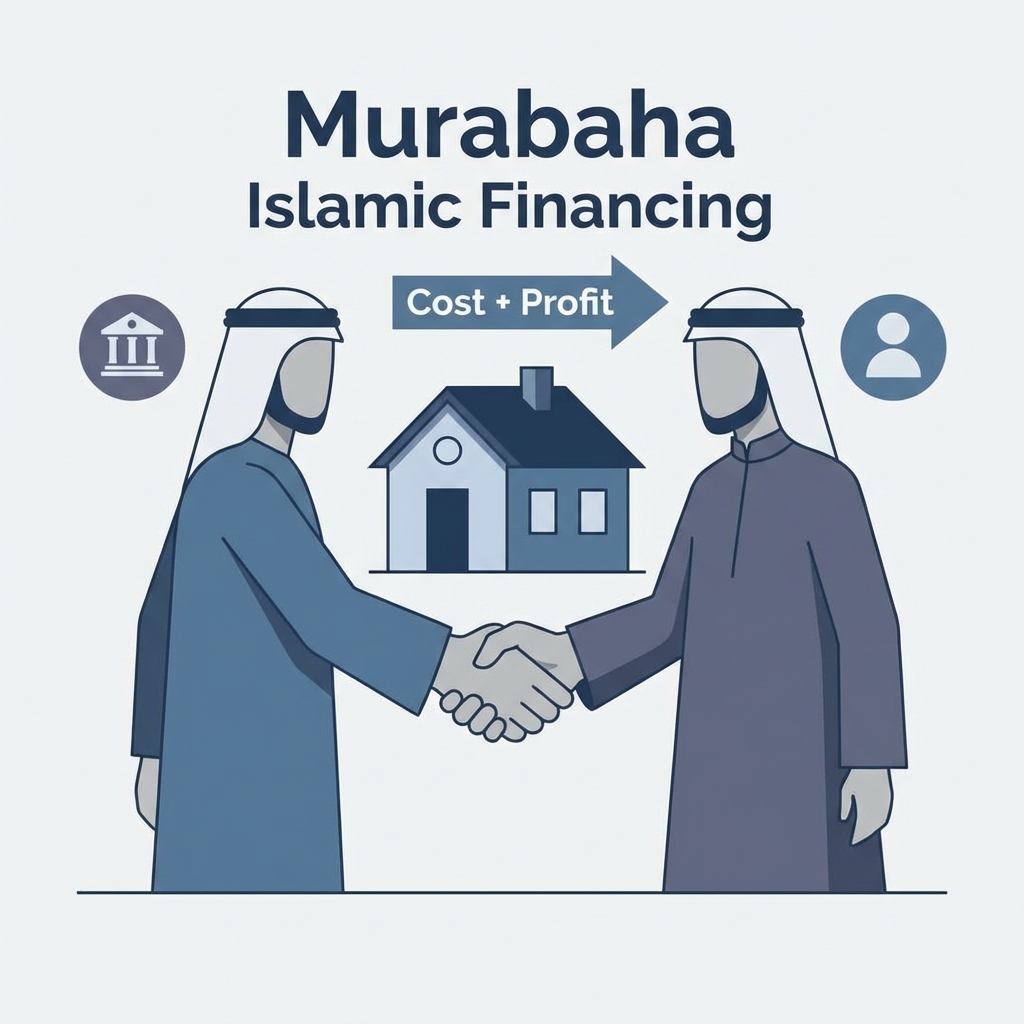
What is Murabaha? Islamic Home Financing Explained
Key Takeaways
- •Murabaha is NOT a loan—it's a sale transaction where the bank buys the home and sells it to you at a markup.
- •There is no 'interest rate' but there IS a 'profit rate' that is disclosed upfront and fixed for the entire term.
- •The total price is agreed upon at contract signing and cannot change—compliant with Sharia prohibition of uncertainty (gharar).
- •Typically requires 20%+ down payment (higher than conventional loans) and may have limited financing provider options.
- •The end result looks similar to a conventional halal home financing, but the structure is fundamentally different.
For Muslim homebuyers, conventional islamic mortgages present a religious dilemma: Riba (interest) is explicitly forbidden in Islam. Murabaha financing offers a Sharia-compliant alternative that allows Muslims to purchase homes without violating Islamic principles. But how does it actually work, and is it truly different from a conventional halal home financing? Let's break it down.
What Is Murabaha?
Murabaha (Arabic: مرابحة) means 'cost-plus' or 'profit sale.' In Islamic finance, it refers to a transaction where:
- The bank purchases an asset (your home) at market price
- The bank discloses the cost to you
- The bank sells the asset to you at cost + a fixed profit markup
- You pay the total price in installments over an agreed period (15-30 years)
This is a SALE, not a financing. The bank owns the home briefly, then sells it to you. You're buying the home from the bank on a payment plan, not borrowing money to buy it yourself.
How Murabaha Works: Step-by-Step
Step 1: You find a home
You identify a property you want to buy. Let's say it's listed for $300,000.
Step 2: The bank purchases the home
You approach an Islamic finance institution. They buy the home from the seller for $300,000. The bank now owns the property.
Step 3: The bank sells it to you at a markup
The bank says: 'We bought this for $300,000. We will sell it to you for $450,000 (cost + $150,000 profit).' This $450,000 is the total amount you will pay over the life of the contract.
Step 4: You make installment payments
You agree to pay $450,000 over 30 years in monthly installments of $1,250/month ($450,000 ÷ 360 months). The price is FIXED and cannot change.
Step 5: You own the home
The title transfers to you immediately (in most structures), but the bank holds a lien until you've paid the full $450,000. Once paid, the lien is released.
Murabaha vs. Conventional Halal Home Financing: What's the Difference?
On the surface, Murabaha looks identical to a conventional halal home financing:
- You make monthly payments
- The bank holds a lien on the property
- You can lose the home if you default
- The total cost is significantly higher than the purchase price
But the underlying structure is different:
Conventional Halal Home Financing:
- You borrow $300,000 from the bank
- You pay profit on the financing (e.g., 6.5% APR)
- The profit compounds over time
- Total paid: ~$682,000 over 30 years
- Islamic ruling: Forbidden (Riba)
Murabaha:
- The bank buys the home for $300,000
- The bank sells it to you for $450,000 (fixed price)
- No interest—just a profit on a sale
- Total paid: $450,000 over 30 years
- Islamic ruling: Permissible (trade is halal)
The key difference: In Murabaha, the bank is selling you an asset at a profit. In a conventional halal home financing, the bank is lending you money and charging profit. Islam permits trade but forbids profit.
Are you considering Murabaha financing for your home?
Is the 'Profit Rate' Just Profit by Another Name?
This is the most common criticism of Murabaha. Critics argue: 'You're still paying more than the home's value. How is a $150k profit different from $150k in profit?'
Islamic scholars respond with several points:
1. Fixed vs. Variable
In Murabaha, the total price ($450k) is fixed at signing. If you pay early, you still owe $450k. In a conventional halal home financing, profit accrues daily—pay early and you save money. This difference matters in Islamic law because Murabaha avoids the 'time value of money' concept that underlies Riba.
2. Ownership Transfer
The bank actually OWNS the home (even if briefly). They take on the risk of ownership. In a conventional halal home financing, the bank never owns the home—they just lend you money.
3. Permissibility of Trade
The Quran explicitly permits trade: 'Allah has permitted trade and forbidden Riba' (2:275). Buying low and selling high is the basis of all commerce. The bank bought for $300k and sold for $450k—this is trade, not usury.
The bottom line: Whether you find this distinction convincing depends on your understanding of Islamic finance. Most Islamic scholars approve Murabaha as a valid alternative to conventional islamic mortgages.
Pros and Cons of Murabaha Financing
Pros:
- Sharia-compliant: Approved by most Islamic scholars
- Fixed total cost: You know exactly what you'll pay from day one
- No interest: Avoids Riba
- Peace of mind: Fulfill religious obligations while owning a home
Cons:
- Higher down payment: Typically 20%+ required (vs. 3-5% for conventional)
- Limited lenders: Fewer institutions offer Murabaha (Guidance Residential, Devon Bank, University Islamic Financial)
- Higher total cost: The profit markup may be higher than conventional profit rates
- No early payoff benefit: Paying early doesn't reduce the total amount owed (though some contracts allow negotiated discounts)
- Refinancing complexity: Harder to refinance if rates drop
Real-World Example: Murabaha vs. Conventional
Scenario: $300,000 home, 30-year term, 20% down payment ($60,000)
Conventional Halal Home Financing:
- Loan amount: $240,000
- Interest rate: 6.5% APR
- Monthly payment: $1,517 (P&I only)
- Total profit paid: $306,120
- Total cost: $546,120
Murabaha:
- Bank buys for: $240,000
- Bank sells for: $390,000 (cost + $150,000 profit)
- Monthly payment: $1,083 (fixed)
- Total profit paid: $150,000
- Total cost: $450,000
In this example, Murabaha is actually CHEAPER ($96,120 less) than the conventional halal home financing. However, rates vary by financing provider and market conditions. Always compare offers.
Who Offers Murabaha Financing in the US?
Major Islamic finance institutions:
- Guidance Residential: Largest Islamic halal home financing provider in the US
- Devon Bank: Chicago-based, offers Murabaha and Ijara
- University Islamic Financial (UIF): Michigan-based
- Ameen Housing: California-focused
- Lariba: One of the oldest Islamic finance companies in the US
Important: Get quotes from multiple financing providers. Profit rates and terms vary significantly.
Common Questions About Murabaha
Q: Can I pay off Murabaha early?
A: Technically, you owe the full $450k even if you pay early. However, many financing providers offer a 'rebate' or 'discount' for early payoff (negotiated at closing). This is called 'Hiba' (gift) and is permissible.
Q: What happens if I default?
A: The bank can foreclose, just like a conventional halal home financing. You lose the home and any equity you've built.
Q: Is Murabaha accepted by all Islamic scholars?
A: The vast majority approve it, but a small minority argue it's too similar to conventional islamic mortgages. Consult your local imam or scholar if you have concerns.
Q: Can I use Murabaha for investment properties?
A: Yes, most financing providers offer Murabaha for both primary residences and investment properties.
Bottom Line: A Halal Path to Homeownership
Murabaha financing allows Muslims to own homes without compromising their faith. While it may require a higher down payment and offer fewer financing provider options, it provides peace of mind that your home purchase is Sharia-compliant. As with any major financial decision, compare multiple offers and consult knowledgeable scholars to ensure you're making the best choice for your situation.
👉 [Calculate Your Murabaha Payment](/murabaha) - See what your halal home financing would cost with our Sharia-compliant calculator.
Related Articles
The Complete Guide to Halal Mortgage Options in the USA: How to Buy a Home Without Riba
A comprehensive guide exploring what a Halal mortgage is, how Islamic home financing works in the USA, and the different Sharia-compliant models available.
Murabaha vs. Ijara: Which Islamic Mortgage is Right for You?
The two most popular Islamic home financing models available today are Murabaha and Ijara. Understand the mechanics, benefits, and differences between them.
Ijara Financing: The "Lease-to-Own" Islamic Halal Home Financing
An alternative to Murabaha. Ijara is structure as a manufacturing lease ending in ownership.
Comments (0)
No comments yet. Be the first to share your thoughts!
Contact Us
To ensure absolute accuracy and provide you with documented, Sharia-compliant financing quotes that you can review in your own time, all our preliminary consultations are conducted via email. Fill out the quote form, and our matching team will email you the best options within 24 hours.
For direct inquiries, you can also reach us at: contact@uimortgage.com