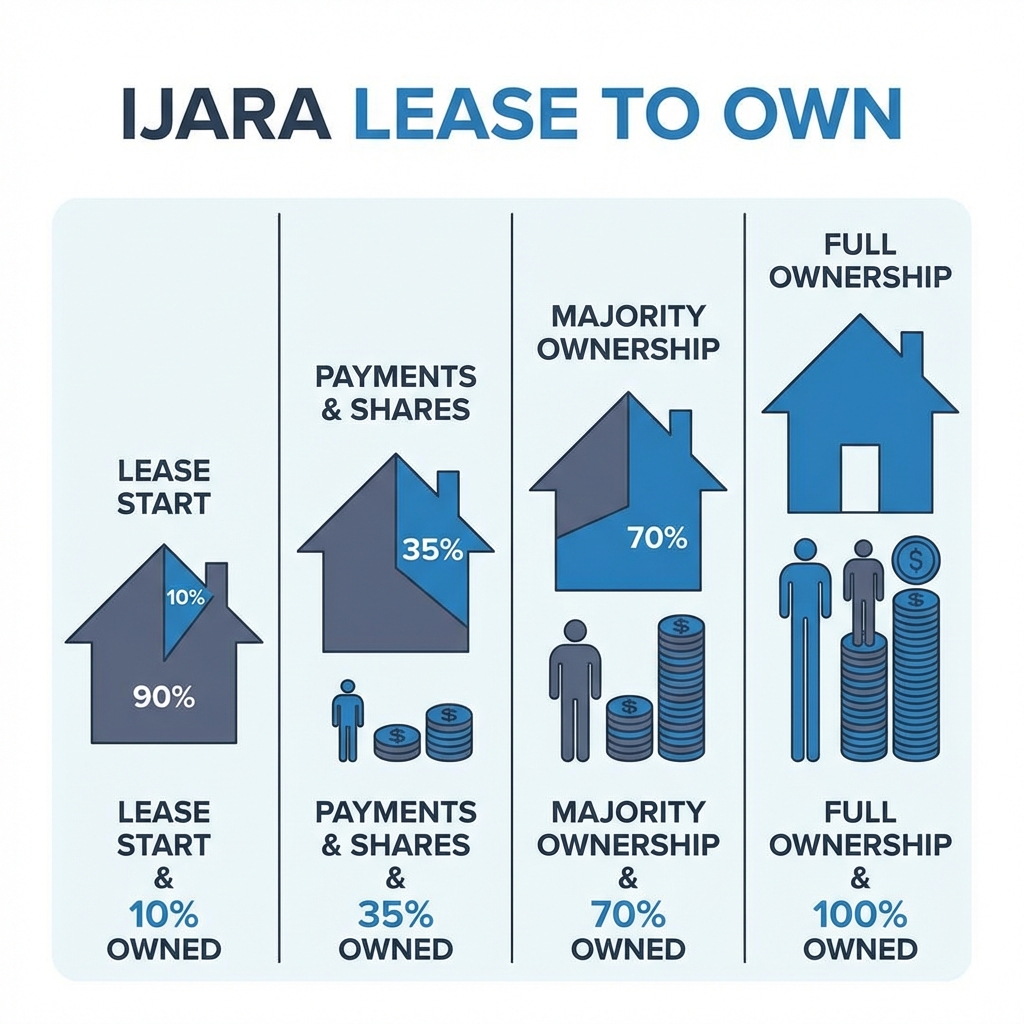
Ijara Financing: The "Lease-to-Own" Islamic Halal Home Financing
Key Takeaways
- •Ijara means 'lease'—the bank purchases the property and leases it to you with an option to buy.
- •Your monthly payment has two components: Rent (paid to bank) + Principal (buying ownership shares).
- •As you acquire more equity, the bank's ownership decreases, and your rent portion goes down.
- •This structure is often used for variable-rate financing or when Murabaha isn't suitable.
- •At the end of the term, you own 100% of the property—the lease converts to full ownership.
Ijara financing is the second major form of Islamic home financing, alongside Murabaha. While Murabaha is structured as a 'cost-plus sale,' Ijara is structured as a 'lease-to-own' arrangement. It's particularly useful for Muslims who want Sharia-compliant financing with more flexibility than Murabaha offers. Let's explore how it works.
What Is Ijara?
Ijara (Arabic: إجارة) means 'lease' or 'rent.' In Islamic home financing, Ijara refers to a contract where:
- The bank purchases the property
- The bank leases the property to you
- You pay monthly rent to the bank
- You simultaneously purchase ownership shares from the bank
- Over time, you transition from renter to full owner
Think of it as a partnership: You and the bank co-own the home. You live in it, pay rent on the bank's portion, and gradually buy out the bank's share until you own 100%.
How Ijara Works: Step-by-Step
Step 1: You find a home
You identify a $300,000 property you want to buy.
Step 2: You make a down payment
You put down 20% ($60,000). This means you immediately own 20% of the home. The bank owns the remaining 80% ($240,000).
Step 3: The bank leases their portion to you
The bank says: 'We own 80% of this home. We'll lease our 80% to you for $1,200/month in rent.'
Step 4: You buy ownership shares monthly
In addition to rent, you pay the bank to purchase ownership shares. For example, you might pay $500/month to buy equity. Your total monthly payment is $1,700 ($1,200 rent + $500 equity purchase).
Step 5: Your ownership increases over time
- Year 1: You own 20%, bank owns 80% → You pay rent on 80%
- Year 10: You own 50%, bank owns 50% → You pay rent on 50%
- Year 20: You own 80%, bank owns 20% → You pay rent on 20%
- Year 30: You own 100%, bank owns 0% → No more rent, you own the home outright
As your ownership grows, your rent decreases (because you're renting less of the home from the bank). But your total monthly payment usually stays the same—the savings on rent go toward buying more equity faster.
Ijara vs. Murabaha: Key Differences
Both are Sharia-compliant, but they work differently:
Murabaha (Cost-Plus Sale):
- Bank buys home, sells it to you at a markup
- Fixed total price from day one
- You own the home immediately (bank holds lien)
- Payment is purely principal reduction
- No early payoff benefit (unless negotiated)
Ijara (Lease-to-Own):
- Bank buys home, leases it to you
- Rent can be variable (adjusted periodically)
- You gradually acquire ownership
- Payment is rent + equity purchase
- Early payoff is simpler (just buy remaining shares)
When to choose Ijara over Murabaha:
- You want a variable-rate structure (rent can adjust with market)
- You plan to pay off early (easier to buy remaining shares)
- You prefer the partnership model over a sale model
- Your financing provider offers better Ijara terms
Which Islamic financing structure appeals to you more?
Is Ijara Truly Sharia-Compliant?
Yes, Ijara is widely accepted by Islamic scholars. The structure is based on two permissible contracts:
1. Ijarah (Lease): Renting property is explicitly halal. The bank owns the property and leases it to you—this is a standard rental agreement.
2. Diminishing Musharakah (Declining Partnership): You and the bank are partners. You gradually buy out the bank's share. Partnership and trade are both halal.
The combination of these two contracts creates Ijara financing. Because both underlying contracts are permissible, the overall structure is Sharia-compliant.
Real-World Example: How Ijara Payments Work
Scenario: $300,000 home, 20% down ($60,000), 30-year term
Initial ownership:
- You: 20% ($60,000)
- Bank: 80% ($240,000)
Monthly payment breakdown (Year 1):
- Rent on bank's 80%: $1,200/month (calculated as fair market rent × 80%)
- Equity purchase: $500/month (buying ownership shares from the bank)
- Total payment: $1,700/month
After 10 years:
- You've paid $60,000 in equity purchases ($500 × 120 months)
- You now own 40% ($120,000)
- Bank owns 60% ($180,000)
- New rent: $900/month (60% of fair market rent)
- Equity purchase: $800/month (accelerated)
- Total payment: Still ~$1,700/month
After 30 years:
- You own 100%
- Bank owns 0%
- Rent: $0
- You own the home outright
Pros and Cons of Ijara Financing
Pros:
- Sharia-compliant: Approved by Islamic scholars worldwide
- Flexibility: Rent can be adjusted (like a variable-rate halal home financing)
- Early payoff: Easier to buy out the bank's remaining shares
- Transparent ownership: You always know exactly what % you own
- Tax benefits: Rent portion may be deductible as halal home financing profit (consult a tax advisor)
Cons:
- Variable rent: If market rents rise, your payment could increase
- Complexity: Harder to understand than a simple Murabaha sale
- Limited lenders: Fewer institutions offer Ijara than Murabaha
- Maintenance responsibility: You're responsible for repairs even though you don't own 100% initially
Who Offers Ijara Financing?
Major providers in the US:
- Guidance Residential: Offers both Murabaha and Ijara
- Devon Bank: Specializes in Ijara (diminishing Musharakah)
- University Islamic Financial (UIF): Michigan-based, Ijara focus
- Ameen Housing: California, offers Ijara for investment properties too
Always compare: Ijara terms vary significantly between financing providers. Get quotes from 2-3 institutions.
Common Questions About Ijara
Q: Who is responsible for property taxes and insurance?
A: Typically, you are—even though you don't own 100% initially. This is negotiated in the contract.
Q: Can the bank raise my rent arbitrarily?
A: No. Rent adjustments are tied to a benchmark (like LIBOR or a housing index) and capped. This is specified in the contract.
Q: What happens if I default?
A: The bank can terminate the lease and sell the property. You lose your equity share, similar to foreclosure in a conventional halal home financing.
Q: Is Ijara more expensive than Murabaha?
A: Not necessarily. It depends on market conditions and financing provider terms. Sometimes Ijara is cheaper, sometimes Murabaha is. Compare both.
Bottom Line: A Flexible Halal Option
Ijara financing offers Muslims a Sharia-compliant path to homeownership with more flexibility than Murabaha. The lease-to-own structure is transparent, allows for early payoff, and can adapt to changing market conditions. If you value flexibility and prefer a partnership model, Ijara may be the right choice for your halal home financing needs.
👉 [Calculate Your Ijara Payment](/ijara-calculator) - See how the lease-to-own model works for your situation.
Related Articles
The Complete Guide to Halal Mortgage Options in the USA: How to Buy a Home Without Riba
A comprehensive guide exploring what a Halal mortgage is, how Islamic home financing works in the USA, and the different Sharia-compliant models available.
Murabaha vs. Ijara: Which Islamic Mortgage is Right for You?
The two most popular Islamic home financing models available today are Murabaha and Ijara. Understand the mechanics, benefits, and differences between them.
What is Murabaha? Islamic Home Financing Explained
How to buy a home without Riba (Interest). Understanding the "Cost-Plus" model of Halal islamic mortgages.
Comments (0)
No comments yet. Be the first to share your thoughts!
Contact Us
To ensure absolute accuracy and provide you with documented, Sharia-compliant financing quotes that you can review in your own time, all our preliminary consultations are conducted via email. Fill out the quote form, and our matching team will email you the best options within 24 hours.
For direct inquiries, you can also reach us at: contact@uimortgage.com