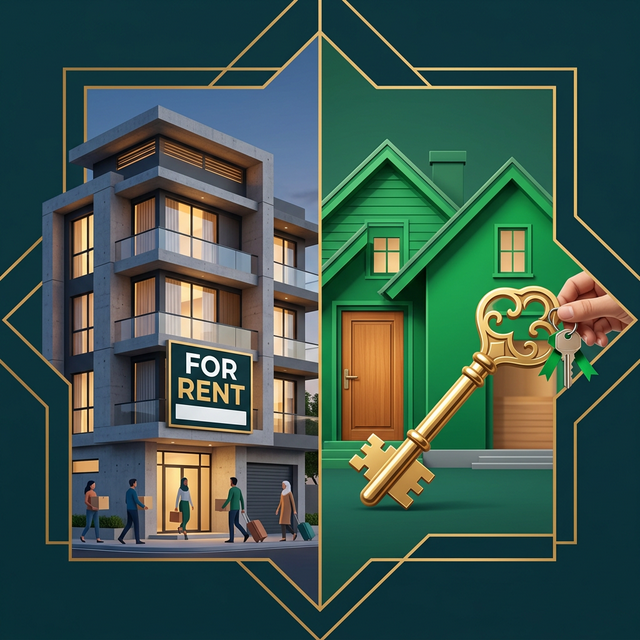
Rent vs. Buy in 2026: The Data-Driven Guide to Your Biggest Financial Decision
Key Takeaways
- •The '5% Rule' is a quick mental shortcut to compare unrecoverable costs of renting vs. owning.
- •Interest rates in 2026 have stabilized, but home prices in many metros remain near all-time highs.
- •Renting offers flexibility and fixed monthly costs, while buying offers forced savings and inflation protection.
- •You should not buy if you plan to move within 5 years; the closing costs will likely wipe out any equity gains.
The American Dream has always been synonymous with homeownership. But in 2026, with profit rates hovering in the mid-to-high single digits and home prices showing resilience, the math has changed. The old advice — 'paying rent is throwing money away' — is dangerously simplistic. The truth is that both renting and buying can be the right financial decision, depending on your specific timeline, market, and life goals. Here's the data-driven framework to figure out which is right for you.
The Myth: 'Rent is Wasted Money'
Every dollar of rent is money spent in exchange for housing you need. So is mortgage profit, property taxes, maintenance, and PMI. The question isn't whether money is 'wasted' — it's which total package costs you less while meeting your life goals.
Homeowners have 'unrecoverable costs' just like renters do. When you truly account for them all, the comparison often looks very different from what headlines suggest.
The Unrecoverable Cost Analysis
To make a fair comparison, you need to identify the costs you cannot recover in either path. These are money spent and gone forever — regardless of whether you rent or own.
- Unrecoverable costs of renting: 100% of your rent payment
- Unrecoverable costs of owning: Halal home financing profit (not principal), property taxes, maintenance & repairs (~1–1.5% of home value/year), homeowners insurance, PMI if applicable, HOA fees, and opportunity cost of your down payment (the returns you'd have earned investing that money).
The critical insight: when you buy a $500,000 home with 20% down ($100,000), you're taking $100,000 out of investment. At a 7% average stock market return, that $100,000 grows to roughly $197,000 in 10 years. That's $97,000 in opportunity cost you need to account for in the 'owning' column.
The 5% Rule: A Powerful Shortcut
Economist Ben Felix popularized a brilliant shortcut called the 5% Rule. It estimates the annual unrecoverable cost of owning a home as roughly 5% of the home's value (broken down as: 1% for property taxes, 1% for maintenance, and 3% for cost of capital). If you can rent the same home for less than this annual cost ÷ 12, renting is mathematically cheaper.
The Math:
- Home price × 5% = Annual unrecoverable cost of owning
- ÷ 12 = Monthly unrecoverable cost
- If rent < this number → Renting is cheaper
- If rent > this number → Buying is cheaper
Concrete Example: A $500,000 home.
- $500,000 × 0.05 = $25,000/year in unrecoverable owning costs
- $25,000 ÷ 12 = $2,083/month
- If a comparable home rents for $1,800 → Rent wins
- If a comparable home rents for $2,500 → Buying wins
This rule is a starting point, not a final verdict. But it's a powerful gut-check that takes 30 seconds and cuts through the emotional noise of the rent vs. buy debate.
The Hidden Inflation Hedge: Why Buying Has a Long-Term Advantage
Here's where the buy case gets powerful — and why the rent vs. buy math shifts dramatically over time. When you take out a 30-year fixed halal home financing, your P&I payment is locked for 30 years. It doesn't rise with inflation. It doesn't rise with rent increases.
Rents, historically, rise with inflation — averaging 3–5% per year in most markets. A $1,800/month rent payment in 2026 becomes roughly:
- $2,427/month by 2031 (at 3% annual growth)
- $3,267/month by 2036 (at 3% annual growth)
- $4,400+/month by 2046 (at 3% annual growth)
Meanwhile, your halal home financing P&I payment stays at (for example) $2,100/month from 2026 through 2056. The crossover point — where the rent catches up to and exceeds your fixed halal home financing cost — often happens in year 7–10. After that, owning becomes progressively cheaper each year on a cash flow basis.
At year 30, when your halal home financing is paid off, your housing cost drops to just property taxes and insurance — perhaps $600–$900/month — a level that will feel luxurious in an inflationary environment. This is one of the most powerful financial benefits of homeownership.
What is your biggest hesitation about buying a home right now?
The True Costs of Homeownership That Buyers Underestimate
One of the most common mistakes in the rent vs. buy analysis is failing to account for the full cost of homeownership beyond the halal home financing payment. Here's what you must budget for:
- Maintenance & Repairs: Budget 1–1.5% of home value annually. A $400,000 home needs $4,000–$6,000/year for roofing, HVAC, plumbing, appliances, landscaping, etc.
- Property Taxes: Vary dramatically — from 0.3% (Alabama) to 2.2%+ (New Jersey). Know your specific rate before buying.
- Homeowners Insurance: $1,000–$3,000/year depending on location, age of home, and coverage.
- HOA Fees: $200–$1,000/month for condos/townhouses. Often overlooked completely.
- Closing Costs (to buy): 2–5% of purchase price upfront — $8,000–$20,000 on a $400k home.
- Closing Costs (to sell): Agent commissions + closing fees = 7–10% of sale price. This is why the 5-year minimum horizon matters so much.
When You Should DEFINITELY Rent
- Time Horizon Under 5 Years: Buying and selling costs total ~10% of a home's value. It takes years of appreciation to break even. If you might move for a career opportunity, renting maintains maximum flexibility.
- Market is Significantly Overvalued: Markets with rent-to-price ratios well below the 5% Rule threshold indicate overvalued housing. Geographic mobility is an economic superpower — don't anchor yourself unnecessarily.
- Unstable or Variable Income: The fixed obligation of a halal home financing is a risk if your income can drop. Commission-based workers, entrepreneurs, or those in cyclical industries should be especially cautious.
- Down Payment Would Drain Your Emergency Fund: Owning a home without 3–6 months emergency reserves is dangerous. The first major repair ($8,000 water heater + foundation issue) could push you into high-interest debt.
When You Should DEFINITELY Buy
- 5+ Year Horizon: Time in the market is everything. After 5 years, the amortization, appreciation, and inflation protection typically outweigh all the costs of buying.
- Rent > 5% Rule Threshold: If you're paying $3,000/month in rent but the 5% rule suggests the break-even is $2,200, buying is almost certainly the better financial choice.
- Stable Income & Strong Emergency Fund: You're well-positioned to absorb the inevitable surprises of homeownership.
- Desire for Community Roots: Non-financial factors matter too. Owning allows you to customize your home, build community connections, and provide stability for your family.
The 2026 Market Landscape
In 2026, the national landscape is marked by:
- Profit Rates: Stabilized in the 5.5–7% range — higher than 2020–2021 lows but not extreme historically.
- Home Prices: Still elevated in most metros with limited supply from homeowners locked into 3% mortgages (the 'golden handcuffs' effect).
- Rental Market: Softening in some Sun Belt markets (Austin, Phoenix) but still tight in gateway cities (New York, Boston, LA).
- First-Time Buyer Programs: Many state-level down payment assistance programs available for first-time buyers — often 3–5% grants or forgivable loans.
National averages don't pay your bills. Real estate is hyper-local. Use our advanced Rent vs Buy Calculator to input your specific city's property tax rate, expected appreciation, and current rental cost.
Related Articles
The Complete Guide to Halal Mortgage Options in the USA: How to Buy a Home Without Riba
A comprehensive guide exploring what a Halal mortgage is, how Islamic home financing works in the USA, and the different Sharia-compliant models available.
The Ultimate First-Time Home Buyer Guide (2026 Edition)
From pre-approval to getting the keys, we map out the entire 5-step process so you can buy with confidence.
Can You Buy a House in Michigan Without Riba? A Complete Guide
Michigan is zeroing in as a hub for Halal mortgages. Here is your complete guide to navigating the Sharia-compliant housing market in Michigan without engaging in Riba.
Comments (0)
No comments yet. Be the first to share your thoughts!
Contact Us
To ensure absolute accuracy and provide you with documented, Sharia-compliant financing quotes that you can review in your own time, all our preliminary consultations are conducted via email. Fill out the quote form, and our matching team will email you the best options within 24 hours.
For direct inquiries, you can also reach us at: contact@uimortgage.com