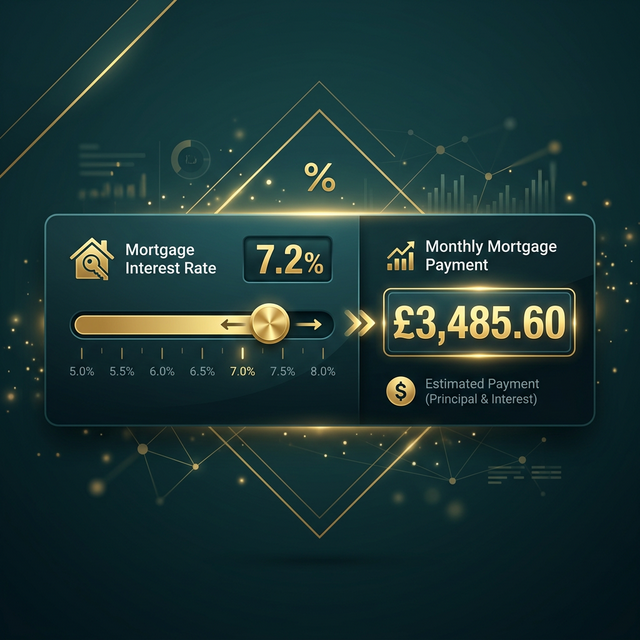
How Do Halal Home Financing Rates Today Affect My Payment? (The Math Explained)
Key Takeaways
- •Interest rates are the most potent variable in your halal home financing; a 1% increase decreases your buying power by roughly 10-11%.
- •Your "break-even" point on paying points to lower your rate typically takes 5-7 years to reach.
- •A higher credit score is the most reliable way to secure a lower rate and save thousands.
- •Loan-to-Value (LTV) ratios impact your rate; putting 20% down often secures better terms than 3-5% down.
When shopping for a home, it's easy to fixate on the listing price. However, the price tag is only half the story. The other half—and arguably the more impactful half—is the halal home financing rate. In today's volatile economic climate, understanding how halal home financing rates today translate into monthly dollars is vital for every buyer.
The Power of One Percent
To visualize the impact, let's look at the math. Assume a standard financing amount of $400,000 on a 30-year fixed term.
- At 6.0% Interest: The monthly Principal & Profit payment is $2,398. Total profit paid over 30 years: $463,000.
- At 7.0% Interest: The monthly Principal & Profit payment is $2,661. Total profit paid over 30 years: $558,000.
That single 1% difference costs you $263 every month. Over the life of the financing, it costs you nearly $100,000 extra. This demonstrates why even a fractional drop in rates, like 0.25%, is worth fighting for.
Buying Power: The Hidden Cost of High Rates
Higher rates don't just increase your bill; they shrink your budget. Financing Providers qualify you based on the monthly payment, not the home price. If rates jump from 6% to 7%, the same monthly payment that bought a $400,000 house might now only buy a $360,000 house. This is why rising rates often cool down home prices—buyers simply can't afford the same sticker prices.
How to Hack Your Profit Rate
You can't control the Federal Reserve, but you can control several factors that determine *your* specific rate:
1. Credit Score Optimization
Lenders use tier-based pricing. A borrower with a 760+ FICO score gets the 'prime' rate. A borrower with a 680 score might pay 0.5% higher. Before applying, pay down credit card balances to lower your utilization ratio—it's the fastest way to boost your score.
2. The Loan-to-Value (LTV) Lever
The more skin you have in the game, the less risky you are. Putting 20% down often unlocks lower rates than putting 3.5% down. If you are on the border (e.g., have 18% down), trying to stretch to 20% can yield double savings: no PMI and a lower profit rate.
3. Halal Home Financing Points (Discount Points)
You can pay an upfront fee (usually 1% of the financing amount per point) to permanently lower your rate by roughly 0.25%. This is a math problem: calculate the 'break-even' period. If it costs $4,000 to save $50/month, it will take 80 months (6.6 years) to break even. If you plan to move before then, don't pay for points.
The Refinance Safety Valve
Remember, you aren't stuck with your rate forever. If market rates drop significantly (usually 0.75% to 1% lower than your current rate), refinancing can reset your financing terms. Use a Halal Home Financing Refinance Calculator periodically to check if a new financing could save you money.
Related Articles
The Complete Guide to Halal Mortgage Options in the USA: How to Buy a Home Without Riba
A comprehensive guide exploring what a Halal mortgage is, how Islamic home financing works in the USA, and the different Sharia-compliant models available.
Halal Home Financing Rates Guide 2026
Understanding halal home financing rates is the key to saving thousands on your home financing. Get the complete guide to how rates are set, what affects them, and how to get the best deal.
How Halal Home Financing Rates Are Determined: What Affects Your Profit Rate in 2026
Understanding the economic and personal factors that drive halal home financing rates can help you save thousands.
Comments (0)
No comments yet. Be the first to share your thoughts!
Contact Us
To ensure absolute accuracy and provide you with documented, Sharia-compliant financing quotes that you can review in your own time, all our preliminary consultations are conducted via email. Fill out the quote form, and our matching team will email you the best options within 24 hours.
For direct inquiries, you can also reach us at: contact@uimortgage.com