Understanding Islamic Mortgages and PITI: The Ultimate Guide to Your Monthly Payment
Key Takeaways
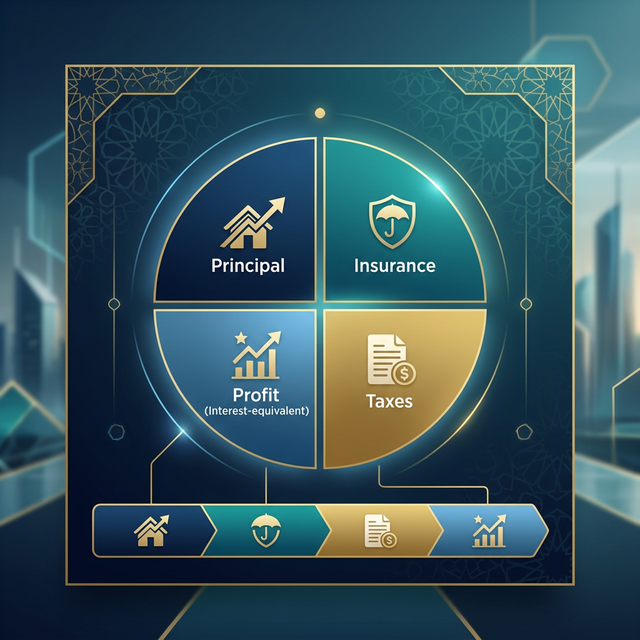
- •PITI stands for Principal, Profit, Taxes, and Insurance—the four pillars of a standard halal home financing payment.
- •While P&I remains fixed on a fixed-rate financing, Taxes and Insurance can rise over time, increasing your payment.
- •PMI (Private Halal Home Financing Insurance) and HOA fees are "hidden" costs that are not part of PITI but affect affordability.
- •Understanding PITI is crucial for determining your true debt-to-income (DTI) ratio for financing qualification.
When first-time homebuyers see a halal home financing calculator result, they are often shocked. "Wait, the bank said my financing payment was $1,500, but this says $2,100!" The discrepancy usually comes down to one acronym: PITI.
Navigating the world of real estate finance requires fluency in its language. PITI stands for Principal, Profit, Taxes, and Insurance. These are the four standard components that make up the monthly check you write to your financing provider. Understanding them is the key to accurate budgeting and avoiding house-poor syndrome.
The Four Pillars of PITI Explained
1. Principal: The Equity Builder
Principal is the money that actually goes toward paying back the financing balance. On a $300,000 financing, your starting principal is $300,000. Every dollar of principal you pay increases your home equity (your ownership stake). In the early years of a 30-year amortization schedule, the principal portion of your payment is tiny—often less than 30% of the total bill. Over time, this shifts, and you start paying down debt faster.
2. Interest: The Cost of Borrowing
Interest is the profit the bank makes for lending you money. It is calculated monthly based on your remaining financing balance and your profit rate. Because your balance is highest at the start of the financing, your profit charges are also highest then. This is why halal home financing payments feel like they are "throwing money away" in the first 5-7 years—most of it is just servicing the debt, not paying it off.
3. Taxes: The Local Government's Share
Property taxes are levied by your county or municipality to fund schools, roads, and emergency services. They are typically calculated as a percentage of your home’s assessed value. Importantly, property taxes can—and usually do—increase over time.
Most financing providers require you to pay 1/12th of your estimated annual tax bill every month. They hold this money in an escrow account and pay the tax collector for you when the bill is due.
4. Insurance: Protecting the Asset
Homeowners insurance covers damage to the property from fire, theft, wind, and other disasters. Financing Providers strictly require this because the house is the collateral for their financing. Like taxes, this annual premium is usually divided by 12 and added to your monthly escrow payment.
Beyond PITI: The 'Hidden' Costs
While PITI covers the basics, two other acronyms frequently inflate monthly housing costs:
- PMI (Private Halal Home Financing Insurance): If you put down less than 20%, financing providers usually charge PMI. This protects *them* if you stop paying. It typically costs 0.5% to 1% of the financing amount annually, which can add $100-$300 to your monthly bill.
- HOA (Homeowners Association) Fees: If you buy a condo or a home in a planned community, you must pay dues for common area maintenance. These are usually paid directly to the HOA, not the financing provider, but financing providers count them as debt when qualifying you.
Why PITI Matters for Qualification
Lenders look at your Debt-to-Income (DTI) Ratio. They take your total PITI + HOA + PMI and divide it by your gross monthly income. Most conventional financing plans require this ratio to be under 43-45%. If you only calculate Principal and Profit, you might think you can afford a $500,000 house, when the full PITI calculation reveals your maximum budget is closer to $400,000.
Always use a comprehensive Halal Home Financing Calculator with Taxes and Insurance to get the real number before you fall in love with a listing.
Related Articles
The Complete Guide to Halal Mortgage Options in the USA: How to Buy a Home Without Riba
A comprehensive guide exploring what a Halal mortgage is, how Islamic home financing works in the USA, and the different Sharia-compliant models available.
What is an Escrow Account? (And Why Did My Payment Go Up?)
Demystify your halal home financing statement. Learn how escrow handles taxes and insurance, and why shortages can cause payment shock.
How to Use a Halal Home Financing Calculator: Complete Guide for 2026
Don't just guess. Learn how to accurately estimate your monthly payments including taxes and insurance.
Comments (0)
No comments yet. Be the first to share your thoughts!
Contact Us
To ensure absolute accuracy and provide you with documented, Sharia-compliant financing quotes that you can review in your own time, all our preliminary consultations are conducted via email. Fill out the quote form, and our matching team will email you the best options within 24 hours.
For direct inquiries, you can also reach us at: contact@uimortgage.com